📈 Prices Are Going Up!
For her school project, Yasmine studies prices in her country with her mom. Learn the words of the cost of living (food, rent, transportation, utilities…), explain increases and decreases ("Prices are going up." · "Gas prices are down."), react to bad news — "Ouch! That hurts." — and make adverbs: slow → slowly, good → well.
A Project About Prices
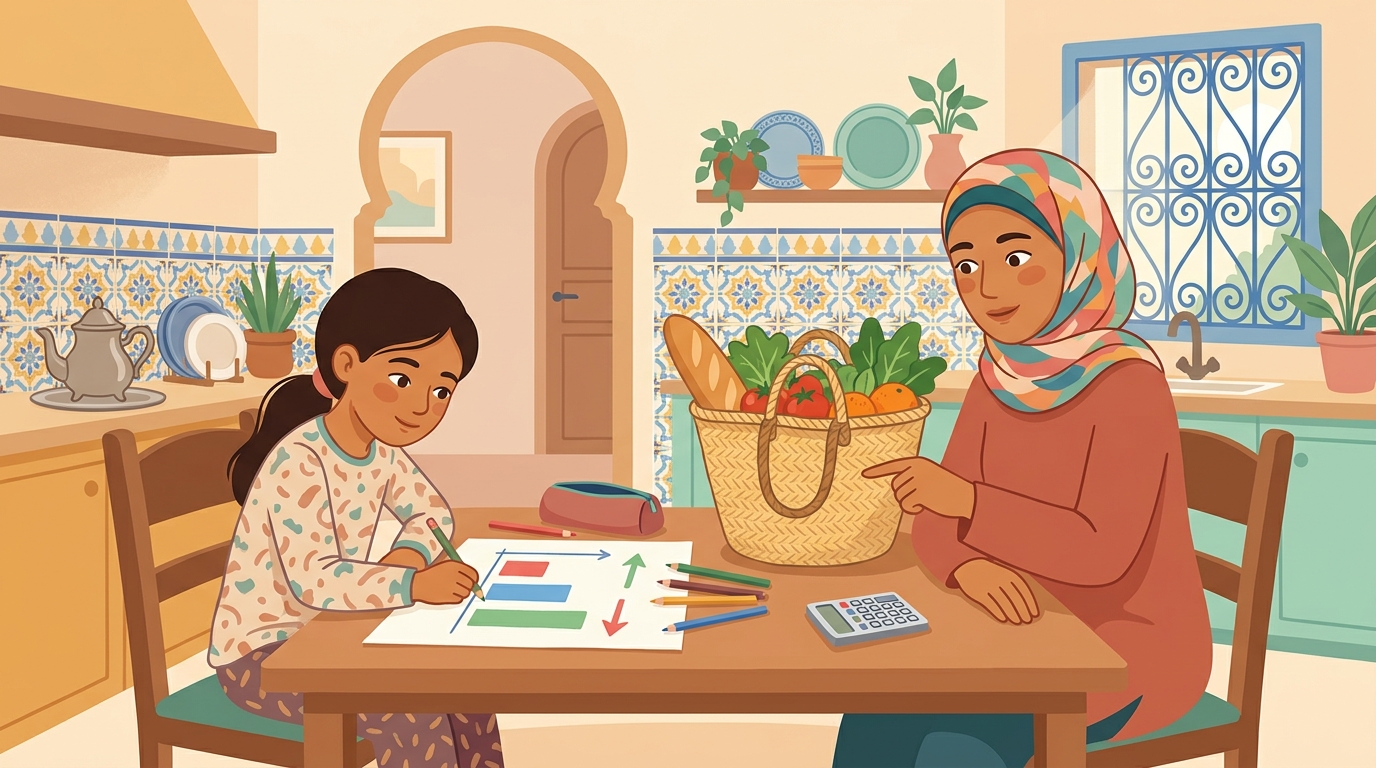
Wednesday afternoon. Yasmine has a school project: "Talking about prices in your country". She asks her mom for help.
🤔 What do families in your country spend the most money on?
🧾 The Cost Of Living
Click each card to hear the word. These are the things people pay for every month or every year.
In American English, gas (or gasoline) is the fuel for cars — "Gas prices are going up." Rent = the money you pay every month to live in a house or an apartment that isn't yours. Utilities = water, electricity and gas for the home. Sales = how much a company sells.
🗂️ The Budget Sorter
Mom paid for these things this month. Which category is each one? 8 receipts.
📈 Explaining Increases And Decreases
Is it going up ⬆️ or down ⬇️? Three ways to say it!
⬆️ An increase
- Prices are going up. (now)
- The rent is going to increase. (future)
- Company sales are up. (the result)
- The cost of living is going up and up.
⬇️ A decrease
- Company sales are going down. (now)
- The temperature is going to decrease. (future)
- Gas prices are down. (the result)
- The price of phones is down 10%.
Ouch! That hurts. When you get bad news about an increase or a decrease, you can say that it hurts. It doesn't physically hurt — it means the news is unwelcome. A: The price of food is up 25%. B: Ouch! That hurts. · Good news? Say That's good news! or Great!
📊 The Trend Machine
Choose a cost, up or down, and when. Watch the arrow and listen to the sentence!
🤕 Ouch Or Good News?
Listen to the news and react. Is it bad news for the family, or good news? 8 news.
🏭 Adverbs With -ly
Adverbs of manner tell us how something happens. They modify the verb. Usually: adjective + -ly.
➕ adjective + -ly
- slow → slowly: The price is decreasing slowly.
- quick → quickly: The price is decreasing quickly.
- careful → carefully
✏️ consonant + y → i + ly
- busy → busily: The people in the office are working busily.
- lazy → lazily: The cat is walking lazily down the street.
- easy → easily · happy → happily
🌟 No -ly!
- good → well: He is doing well in school.
- fast → fast: Gas prices are going up fast.
- hard → hard: She studies really hard.
Adjective or adverb? An adjective describes a noun: a slow bus, a careful driver. An adverb describes a verb: the bus moves slowly, he drives carefully. And careful: hardly ≠ hard! "I hardly study" = I almost don't study. 😅
🏭 The Adverb Factory
An adjective goes into the factory… which adverb comes out? 10 adjectives.
🎯 Adjective Or Adverb?
Does the word describe a noun or a verb? Choose the right form. 8 sentences.
Listen And Repeat!
Click 🔊 Listen to hear the phrase, 🐢 Slowly to hear it slower, then 🎙️ My turn and say it out loud into your microphone!
✍️ Practice Time!
Exercise 1 — True Or False?
Exercise 2 — Complete The Dialogue
Fill in the missing word in each line of the conversation.
🎭 Create & Record: Prices In My Country
Interview a parent about prices, then write the conversation. Ask about three costs (food, transportation, clothing, school supplies…). Use going up / going down, is up / is down, a reaction (Ouch! That hurts. or That's good news!) and two adverbs (slowly, quickly, well, carefully…).
🎙️ Now, Record It!
Read your interview out loud with your parent — like a radio reporter! Then listen back.
🎯 Final Quiz — Prices & Adverbs
Answer 7 questions to test everything you learned in this lesson!